

Originally posted April 7, 2025 on LinkedIn
Last week, ChatGPT quietly dropped a major update: built-in, ultra-realistic image generation using just text prompts.
So, naturally, I gave it a challenge.
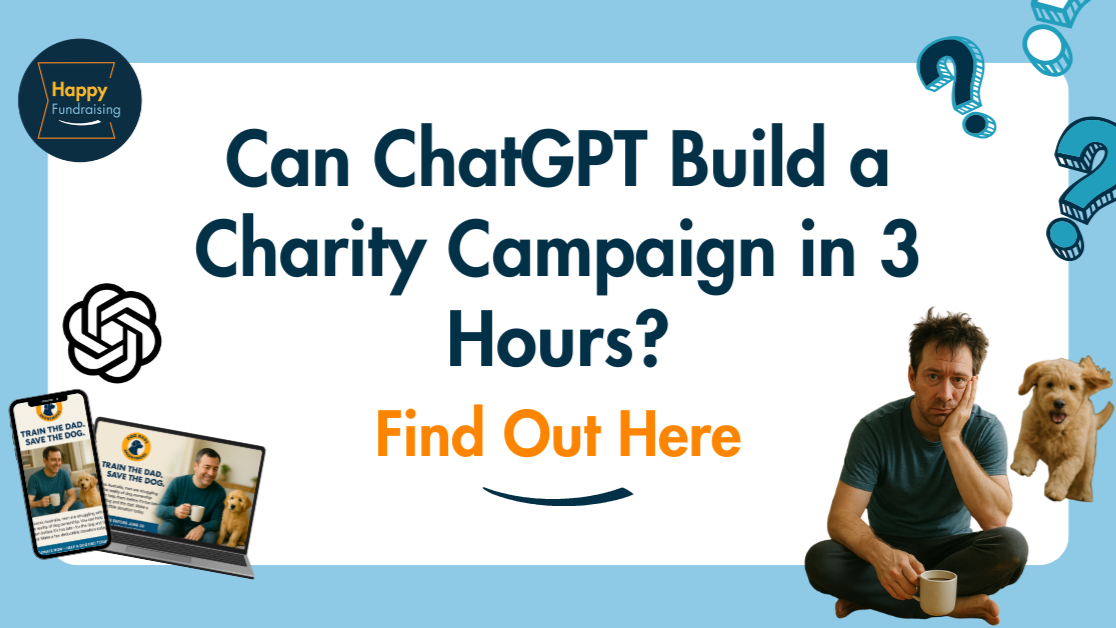
Could I create a complete charity appeal—from concept, to photography, to mock donation page—in 3.5 hours using only AI?
This wasn’t a test of writing copy or building a fundraising strategy. It was a test of something much narrower but equally exciting:
✨ Can ChatGPT’s new image feature create consistent, photo-realistic, campaign-ready imagery fast enough and good enough to rival stock photography?
Let’s find out…
🔪 The Setup: Creating a Fictional Charity
I created a fictional tax appeal for a made-up mental health charity called Dog Dads Anonymous. Their mission? To provide mental health and behavioural support for overwhelmed first-time dog owners.
The campaign followed ‘Mark‘ and his Groodle-puppy ‘Philly’ through the emotional ups and downs of early dog parenthood. I wanted
- 6 photo-realistic photos of my case study Mark, and his puppy Philly.
- A new logo for my made up charity.
- A good-looking landing page optimised for both mobile and desktop.
Could GTP deliver the goods in one morning?… Let’s find out!
🖼️ Phase 1: The Images
ChatGPT not only created the prompts but walked me through the process.
I literally asked it: “What’s the best way to generate consistent images for a campaign using your new tool?” It gave me a step-by-step plan for uploading reference photos, building scenes around a case study arc, and refining prompts until I got what I needed.
I began with four original uploaded images, including:
- 4 images of me; two sad, two with (slightly awkward) smiles
- 4 of our Head of Innovation and Cuddles, Philly the Groodle


Each image was generated to match a different emotional phase of the narrative. But now reader… I hope you’ve noticed something: the AI’s version of “me” looks nothing like me.
This was the first major fail.
Despite uploading multiple reference images, the outputs were, shall we say, creatively interpreted. The guy in the final campaign scenes looks like he lives in an Airbnb and owns a juicer. I don’t.
In fairness, I’m sure if I had more time to experiment and fine-tune the prompts, I could’ve gotten closer. But that wasn’t the point of this test. And for this use case, it didn’t need to be me — it just needed to be a consistent character. And it got that sort-of ok.
So here’s the key takeaway:
👉 If you’re trying to recreate a specific person, it still struggles.
👉 But if you’re using stock-style imagery anyway and just need a consistent “everyman,” you can get pretty close already. Give it 6 months, and this will be easy!
📱 Phase 2: Building the Landing Page
Once the images were ready, I used ChatGPT to build out a simple, vertically scrolling landing page in six blocks: hero, story, services, recovery, call to action, and thank you.

Before doing this, I also asked it to generate a logo for the fictional charity. I think it did an excellent job.
To give it even more guidance, I uploaded the hex codes from my Happy Fundraising brand to steer its colour choices. I also referenced previous landing page designs I had worked on, so ChatGPT understood the layout and styling preferences I typically use.
It took all of this—my colour palette, my tone prompts, my preferred layout style, and the newly created images—and pulled together the first version of the landing page.
And let me be clear: this was its first attempt. I didn’t give it any layout corrections or adjustments. It just produced the full-page mockup from scratch. And honestly? It did a pretty darn good job.


It did encounter a few issues though.
Despite my best attempts, it still wanted to ‘re-imagine’ my photos, so the fake-mark looks different here than the original renders.
It liked to crop images in strange places. With some re-prompting, you can correct this, but it can be painful.
Inconsistent style—you’ll see the phone frames it’s given me are all slightly different, and it didn’t want to play ball easily here. Exporting to Photoshop or Canva and doing things ‘the old-fashioned way’ might actually be quicker with these refinements.
💡 Unexpected Revelation: AI = Great Briefing Tool
Mocking up this appeal gave me something far more valuable than I expected—a visual prototype to brief designers or developers.
It’s always hard to convey “I want the donation page to feel like this.” But with this new tool, I could show, not tell.
This AI-generated landing page isn’t the final masterpiece. But it’s the faint outline of the statue — a working draft with structure, tone, imagery, and layout ready for a real creative team to carve and polish.
🤔 So… Is It Good Enough for Charity Campaigns
Not yet.
But if your appeals already use stock imagery, this is very close to being a viable replacement.
✅ What worked:
- Photo-realistic quality
- Fast turnaround
- Huge cost savings
- Perfectly matched scenes to your story arc
- Visually consistent design
⚠️ What didn’t:
- Getting the same face across all images (not yet reliable)
- Prompting precision (cropping, text space, safe areas)
- Still not suitable for real beneficiary stories
If you’re using real people and real stories—stick with that. Authenticity still wins.
But if you’re testing Meta ads, mocking up internal concepts, or creating early-stage creative for feedback? This changes the game.
🔮 The Near Future
In 6–12 months, this will be better than stock images.
You’ll be able to upload a few reference shots of your beneficiary and generate new scenes that look just like them—different outfits, lighting, poses, all consistent.
We’re not there yet.
But we’re very close.
🔨 The Verdict
Nothing beats images for REAL beneficiaries that you have helped. Authenticity will always win the day.
Come back soon, and you’ll likely see the end of stock images in charity campaigns.
In the, probably not-to-distant, future, you’ll be able to imagine your strategy, create all your images, write all your copy, code your landing page, and analyse your results all within ChatGPT or something similar. My prediction is AI capability will soon become a must-have skill for any fundraiser.
Things are changing fast, hopefully for the better.
Connect with Happy Fundraising to keep up to date with all the latest Fundraising trends.